
The AI Architect's Edge: Where Business Strategy Meets Architecture
How Think2Steer AI Signals connects business decisions, policy, AI architecture, evidence, and measurable value
Building an AI system is becoming easier. Deciding whether the customer should build it at all is harder.
An architect can select a foundation model, design retrieval, add orchestration, and deploy scalable infrastructure. But those technical choices do not answer the first questions a customer should ask:
- Should this workflow use AI?
- Would deterministic automation solve most of the problem?
- Does the answer depend on current or proprietary evidence?
- Does the workflow genuinely need an agent?
- Would faster processing change a business decision?
- What evidence would justify the additional cost?
An AI Business Strategist asks: Should this exist? What outcome should change? What is it worth?
A Forward Deployed Engineer or AI solution architect asks: How should it work? How do I make it safe, reliable, and operable?
The strongest customer-facing architect can ask both sets of questions before complexity becomes commitment.
The overlap is the edge.
In this post, I use the Think2Steer AI Signals platform as a working case study. The objective is not simply to describe how the platform is built. It is to show how business decisions shaped what I built, what I deliberately kept deterministic, where I introduced AI, and what I would measure before the system earned the right to scale.
From business question to production decision
The architecture should emerge from a decision journey:
Business decision → Baseline → Policy and constraints → Build, buy, or partner → Rules, AI, RAG, or agent → Model and processing path → Evidence and human authority → Measurement and ROI → Stop, improve, or scale
This ordering matters. If the conversation starts with a model or cloud service, the team can optimize an implementation before proving that the workflow needs AI. The architecture diagram is an answer to these decisions. It is not the starting point.
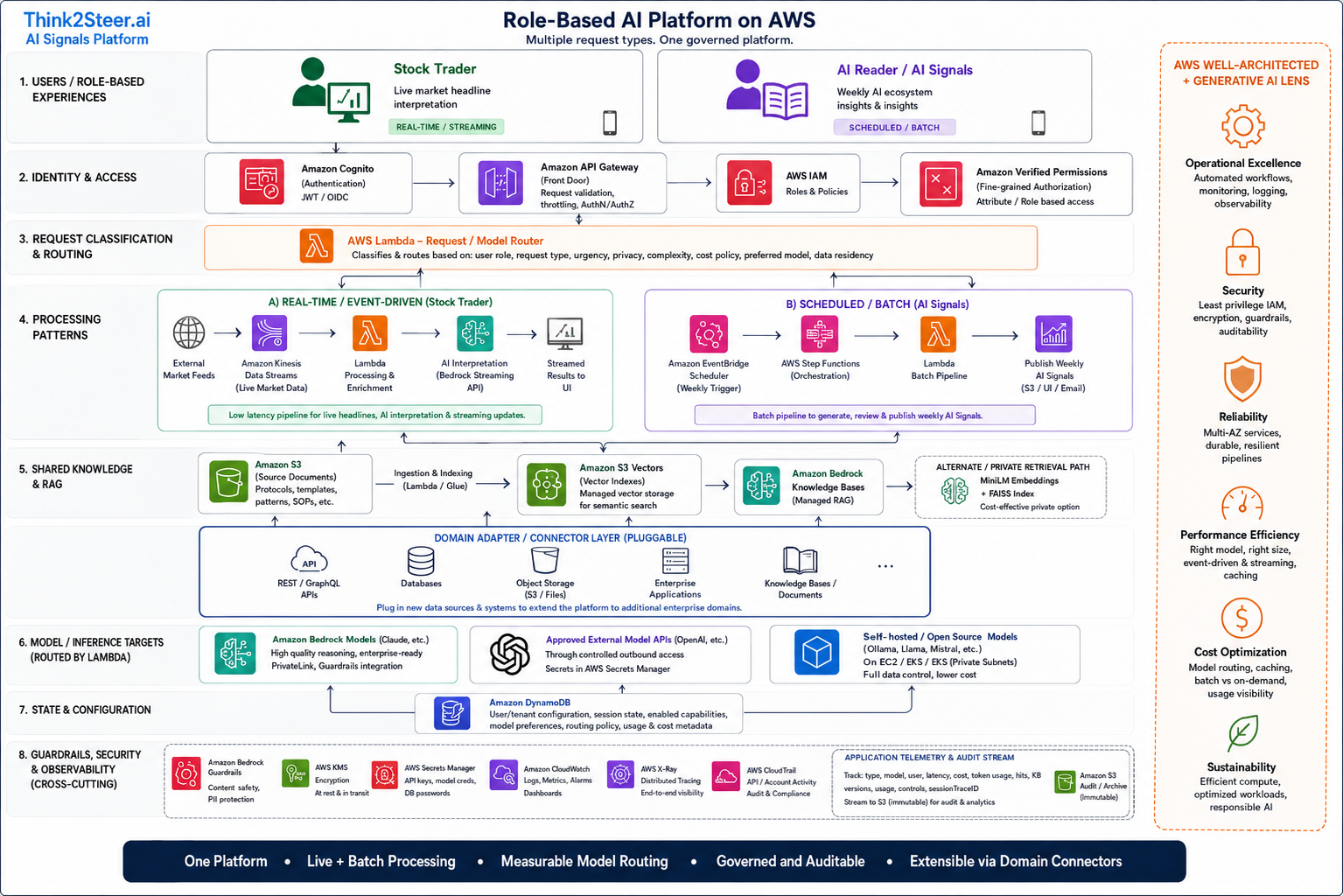
Solution overview: Think2Steer AI Signals
AI Signals is a configurable, multi-tenant intelligence platform with policy-based multi-model routing, RAG-backed enrichment, and domain-specific signal workflows. It is designed for secure, highly available deployment across local and AWS environments.
At a high level, the platform turns approved source material into structured, evidence-aware signals through these layers:
- External and enterprise sources provide approved input material.
- A Domain Adapter / Connector Layer isolates source-specific integration from the shared platform.
- Ingestion and normalization create a consistent internal representation.
- Deterministic processing and AI enrichment apply explicit rules and bounded interpretation in the appropriate places.
- Evidence, retrieval, and impact context connect related signals and supply context to Q&A flows.
- Stored signals and materialized snapshots separate durable results from interactive presentation.
- Workspace, Q&A, alerts, and briefings expose the results to users.
Two cross-cutting controls shape this flow. The Domain Pack expresses domain and customer policy: sources, intelligence fields, processing behavior, model policy, roles, and presentation settings. The model gateway handles logical model tiers, overrides, caching, output checks, processing budgets, fallback behavior, usage metadata, and routing records.
The same platform boundary can support scheduled batch, user-triggered processing, or event-driven processing when the decision justifies it. The domain connector makes the pattern reusable without forcing every customer into a separate application fork.
The same platform across domains
These screenshots show the shared AI Signals workspace rendered for different domain packs. The domain changes the sources, fields, policy, and presentation; the platform boundary remains reusable.


Decision 1: What decision am I improving?
Imagine a customer managing a large and changing body of information. People collect updates, remove duplicates, determine what matters, interpret the change, check supporting evidence, and prepare an output.
The first question is not “Which model should I use?” It is: What decision is the customer trying to make better, faster, or more consistently?
The actual constraint may be slow review, missed information, inconsistent interpretation, weak evidence, compliance risk, or cost. Each answer produces a different architecture.
In AI Signals, the domain shown in a demonstration is a reference workload. The important architecture inputs are the shape and sensitivity of the data, how often it changes, how quickly a decision must respond, what evidence the user needs, and what the customer permits the system to do.
If the customer cannot name the decision, current pain, and expected outcome, the architecture discussion should pause. “I want an AI platform” is not yet a use case.
Establish the baseline before adding AI
| State | What it establishes |
|---|---|
| Manual workflow | Current effort, quality, delays, and failure modes |
| Rules-only automation | Value from collection, filtering, validation, deduplication, and structured presentation |
| AI-assisted workflow | Incremental value from interpretation beyond conventional automation |
A manual-versus-AI comparison can give the model credit for improvements caused by a better interface, deduplication, or workflow redesign. That inflates the AI contribution and weakens the investment case.
Compare equivalent source sets, time windows, task difficulty, review standards, and units of work. Useful measures include total human effort, coverage against a reviewer-labeled reference set, evidence-supported claims, serious errors, freshness, reviewer correction effort, accepted outputs, and total workflow cost per accepted output.
Decision 2: What does the customer permit?
Policy is an architecture input, not a paragraph added to a prompt. Which sources are approved? Which information is sensitive? How fresh must the result be? Which models are approved or blocked? Can data use an external API, or must inference remain local? What cost is acceptable per item or run? Which outputs require review?
These answers influence routing, data movement, storage, processing frequency, fallback behavior, operating cost, and presentation.
Domain Pack as a customer-to-platform contract
AI Signals expresses supported configuration through a versioned Domain Pack. The pack declares sources, intelligence fields, processing policy, model policy, roles, and presentation settings. Packs are validated, versioned, and activated before the workspace uses them.
That makes the Domain Pack more than a UI configuration file. It becomes a contract between customer policy and platform behavior.
| Policy input | Architecture consequence |
|---|---|
| Approved sources | Connector selection and ingestion boundary |
| Sensitivity | Data path and model eligibility |
| Freshness | Batch, on-demand, or event-driven processing |
| Model policy | Allowed logical tiers and fallback routes |
| Budget | Caching, processing limits, and route selection |
| Human review | Presentation state and approval boundary |
A policy field does not prove that the policy is enforced. Critical requirements must be traced through validation, execution, identity, access controls, logs, and tests.
Decision 3: Should I build, buy, or partner?
Building AI Signals does not prove that building is normally the right answer. An existing product may already provide acceptable source coverage, evidence trails, access controls, workflow integration, and exports. If it meets the customer's policy and quality requirements at a reasonable total cost, buying can be the stronger architecture decision.
Building becomes more compelling when the customer needs proprietary context, unusual policy, specialized interpretation, or deep integration into a differentiated workflow. Reusable Domain Packs, normalized signal contracts, and adapter boundaries reduce the risk of creating a separate product fork for every customer.
Partnering can make sense when specialized data access, domain validation, or integration expertise would be expensive to reproduce. Compare total cost of ownership, time to first usable result, policy fit, integration risk, operating burden, quality, and exit options. The visible model bill is only one part of the cost.
Decision 4: What should remain deterministic?
Predictable requirements deserve predictable software.
Authorization, schema validation, exact deduplication, budgets, retries, workflow state, and delivery guarantees are explicit requirements. They belong in deterministic services.
Interpretation is different. Summarizing narrative material, extracting meaning, grouping related evidence, comparing context, or suggesting follow-up questions can justify language-model assistance when the output remains reviewable.
| Deterministic software | AI interpretation |
|---|---|
| Authorization and validation | Narrative understanding |
| Exact deduplication | Summarization and semantic grouping |
| Budgets, retries, and workflow state | Evidence comparison and bounded drafting |
| Delivery guarantees | Suggested questions |
AI Signals keeps these responsibilities separate. Ingestion removes duplicates and filters noise. Enrichment uses language-model and embedding services where interpretation helps. Clustering creates reusable signals. The gateway applies output checks, caching, fallbacks, and usage controls. Q&A assembles selected context and instructs the model to use that context.
If AI extracts an incorrect value, a deterministic rule can faithfully propagate the error. Evaluation must cover the complete chain, not just the final rule or model call.
Decision 5: RAG, agent, or neither?
Ask whether the answer depends on current, private, or customer-specific evidence. If yes, retrieval can assemble relevant context at question time. Before selecting a vector store, define the evidence boundary, retrieval permissions, freshness expectations, evaluation set, and provenance behavior.
AI Signals Q&A extracts entities from the query, uses impact relationships to find relevant nodes and paths, selects related signals, and supplies structured context to the model with an instruction to use that context. This demonstrates grounded context assembly. It does not prove that every original document is retrieved or that every answer is factually correct.
RAG does not automatically improve accuracy. Measure retrieval relevance, evidence-supported claims, missing evidence, unsupported claims, reviewer correction effort, and answer usefulness. If retrieval does not improve grounded output on a representative evaluation set, redesign it or remove it.
Agents solve a different problem. If workflow steps are known, deterministic orchestration is usually stronger because retries, state transitions, authorization, and delivery behavior are easier to test and audit. Consider bounded agent behavior only when dynamic planning solves a real problem and every tool call can be constrained.
“The customer asked for an agent” is not an architecture requirement. Removing an unnecessary agent is a sign of stronger judgment.
Decision 6: Which model and which processing path?
Model selection should not become model shopping. The useful question is: Which approved route meets the quality threshold at an acceptable cost, latency, data boundary, and operating burden?
The AI Signals gateway uses logical model tiers so the application does not need to couple every task directly to one provider. The reference implementation supports tier selection, model overrides, response and embedding caches, processing budgets, fallbacks, output checks, usage metadata, and routing decision records. Local development can use locally hosted models, while cloud paths can use configured API providers.
Evaluate routes using task quality, quality per dollar, latency, data sensitivity, residency, fallback rate, cache behavior, and operational effort. If a smaller or local model meets the threshold, do not pay for a larger route. If no approved route meets it, change the workflow or reject the use case.
Does earlier information change the decision?
Use scheduled batch for a periodic decision, on-demand processing for an interactive request, and event-driven processing only when the business gain pays for the added complexity. AI Signals supports weekly and rolling materialized windows, incremental ingestion, durable local read models, and AWS-oriented data-plane contracts.
If earlier information changes no business decision, do not introduce streaming.
Decision 7: What must the user be able to trust?
Evidence, freshness, and human authority are part of the product experience. A polished answer is still unusable if its supporting context is stale, incomplete, or hidden.
The AI Signals interface reports materialized-snapshot states such as checking, queued, running, stale, ready, failed, and unavailable, together with job identifiers and timestamps. It can retain the last available snapshot while a refresh runs or fails. That improves continuity, but it does not turn stale evidence into current evidence.
Measure source-to-result freshness, stale-view duration, evidence coverage, reviewer corrections, escalation quality, accepted-output rate, and approval time. AI can interpret, draft, and recommend; the customer must define who can approve a consequential change.
Decision 8: Did AI create incremental value?
Return to the three-state baseline: Manual workflow → Rules-only automation → AI-assisted workflow.
Suppose a hypothetical organization produces 100 comparable outputs per month. Manual preparation takes 60 minutes each, rules-only automation takes 45 minutes, and AI-assisted preparation—including review and correction—takes 30 minutes.
AI contributes 15 minutes per output beyond rules-only automation:
100 outputs × 15 minutes ÷ 60 = 25 hours per month
25 hours × $80 = $2,000 potential monthly capacity value
Assume incremental AI operating cost of $800 per month and implementation cost of $6,000:
- Monthly net benefit: $2,000 − $800 = $1,200
- Simple payback: $6,000 ÷ $1,200 = 5 months
- First-year ROI: ($24,000 − $9,600 − $6,000) ÷ ($9,600 + $6,000) = approximately 54%
These figures are illustrative and are not Think2Steer production results. They assume the full capacity value is realized. At half realization, monthly net benefit becomes $200, payback stretches to 30 months, and first-year ROI becomes approximately −23%.
“Time saved” remains potential capacity value until the organization redeploys that capacity, increases useful output, avoids hiring, reduces a measurable cost, or improves another business outcome.
Decision 9: Has the architecture earned the right to scale?
The stop rule belongs in the architecture from the beginning:
- If AI cannot beat rules-only automation at acceptable quality and total cost, remove the AI step.
- If retrieval does not improve grounded output, redesign or remove it.
- If a smaller model meets the threshold, do not pay for the larger route.
- If deterministic orchestration handles the workflow, do not add an agent.
- If faster processing changes no business decision, do not stream.
- If adoption does not convert potential benefit into realized value, revisit the investment.
Scaling requires technical performance, business value, governance, and adoption. When one is missing, improve, simplify, pause, or stop. The ability to remove AI without feeling that the project failed may be one of the most valuable habits an FDE or architect can develop.
The overlap is the edge
An AI Business Strategist without implementation depth can identify where value might exist. An architect without business-strategy depth can build an excellent system.
The FDE who develops both perspectives can challenge the premise, establish the baseline, choose build, buy, or partner, encode policy, select the appropriate architecture, implement the boundary, and prove whether the result deserves to scale.
That is what Think2Steer AI Signals represents in this case study. The platform connects customer policy and data contracts to model routing, durable processing, evidence-aware interpretation, cost controls, and a measurable investment decision.
Technical depth makes sophisticated AI systems possible. Business judgment determines which sophistication is necessary. Measurement establishes whether the system deserves to remain in production.
What is the simplest technically sound solution that produces enough measurable value to deserve production?
Think2Steer AI Signals is used here as a reference case study. Illustrative business calculations are not production results.